Posts

Showing posts with the label welder certification in coimbatore

Radiography Testing procedure

Image
 An Important principle of Radiography Testing procedure is How to arrange for Radiography Testing? Radiography is Non destructive testing method, which utilizes penetrating electromagnetic radiation for capturing the volumetric images of an object on film or digitally in a computer. Radiography testing broadly uses any of the two types of radiation X ray or Gamma Ray for this purpose. Gamma Ray Emitted from radio decaying isotopes. In this case radiation strength cannot be increased or decreased for purpose of inspection components of different material and different thickness. Instead only the expose time can be controlled. After  calculated exposure time, the radiation emitting source is sent back in to a shielded enclosure. X Rays are produced by a electrical system. In this case the strength of radiation can be controlled in relative to the component atomic number and thickness of material. Here we are going to see how to make the radiographic set up and ex...

Difference between Destructive and Non Destructive testing

Image
  Non Destructive Testing  (NDT): NDT is industrial method for analyzing the characteristics of material or finding the discontinuities in the material & Weld joints, without damaging the material. NDT is otherwise called as, Non Destructive Evaluation –NDE. Non Destructive Inspection (NDI) and it a quantitative analysis method.   Destructive Testing : Destructive Testing is a Qualitative analysis method, to find the quality of the material such as Tensile strength, Elongation property, hardness value, Impact toughness, etc. The above mentioned qualitative properties cannot be found using NDT methods. Because in order to find the mechanical properties, it is required to apply load on the material. The load deforms the material making them not usable. But NDT Methods are used in such a manner, that the material can be reused after the testing. Few of the NDT Methods which are used in industries for Defect detection in materials are given below: Ultra...

Preheating in Welding Procedure Specification

Image
  Preheating in Welding Procedure Specification: Preheating is the act of heating the base  metal before starting to weld. It is considered very essential in high thickness materials, Cr-Mo Steels & HSLA High Speed Low Alloy steels, etc… Here we are going to answer the below topics What is Preheating ? Why is Preheat Essential ? What is difference between Preheat, interpass temperature and Post weld heat treatment? How to calculate Pre-Heat Temprature ? Where to Preheat in the material ? What is the requirement of pre heat given in International Standards ? What is Preheating ? It involves heating the base metal to a minimum required temperature before start of the weld. The heat should be maintained until the welding is finished. As per AWS D1.1 Preheat is defined as: The temperature of base metal in the volume surrounding the point of welding, immediately before the welding is started. In a multi-pass weld, it is also the temperature immediately before the second and sub...

Welder Qualification Certificate

Image
  Welding Welding – Process of joining similar metals (or thermoplastic). By heating them to suitable temperature May or may not require pressure May or may not require Filler metal Brazing -Process of joining dis-similar metals . By Melting and pouring the filler metal and pouring on to the joint Both the metals are pre-heated to a suitable temperature Filler metal fills the joint gap by capillary action. Welding Equipment Different Welding Processes SMAW –Shielded Metal Arc Welding TIG / GTAW – Tungsten Inert Gas GMAW /MIG – Gas Metal Arc Welding FCAW – Flux Cored Arc Welding SAW – Submerged Metal Arc Welding ERW – Electric Resistance Welding FSW – Friction Stir Welding Electron Beam Welding And Lot more ……. Welding Codes & Standards ASME section IX – Welding & Brazing qualification ASME B31.1 – Power Piping ASME B 31.3 – Process Piping ASME Section VIII – Pressure Vessel AWS D 1.1 – Structural Steel Welding AWS B 2.1 – Specificatio...

Welding Inspections- All you need to know about Metals

Image
Welding is a process of joining similar metals, i.e. Metals with same base content and similar properties or melting point.There are different types of welding methods based on the process of welding. Generally it involves heating of the metal and fusing them, with or without additional filler metal. The content below answers your questions: What are the types of Base metals? What is Carbon Steel and what is Alloy Steel? What is purpose of alloying element in steel? How are steels classified? Different Base metals in general industry are :- Steel: Low Carbon Steel – C 0.05 to 0.3 % (ex: AISI 1005, 1008 etc) Medium Carbon Steel – C 0.3 to 0.8 % High Carbon Steels – C > 0.8 % (ex. A 36) Alloy Steel – (Cr, V, Co, Mo, Ni, Nb, Ti, W, V, Zr etc.) Stainless Steel (ex: SS304, SS 316 L, etc) Cast Iron – C >2% Aluminum Copper, Brass Titanium Magnesium Alloys Why is Alloying Element added in steel? Alloying elements are added to achieve a spe...

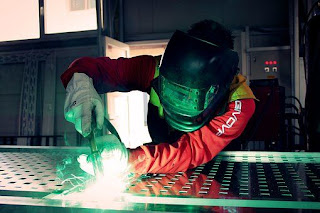
Welding with filler wire- procedure

Image
  Welding is a process of joining two base metals by heating it. It can be done with or without additional filler metal being used. Below are the few types of welding process : 1)Shield Metal Arc Welding, 2) Metal Inert Gas Welding 3) Tungsten Inert Gas Welding 4) Oxygen fuel gas welding 5) Friction Stir Welding (no filler metal required) 6) Electric Resistance Welding (no filler metal required) and few more…. For welding with additional filler wires, care should be taken that the selected filler wire or electrode is compatible for the metal being joined. Collect the Material Test Certificate of the material . Batch test certificate of the filler wire and verify the values. First step is to check the chemical composition of filler wire. The minimum required chemical content should be present and maximum allowed chemicals should be restricted in the filler wire. If Carbon Equivalent value is restricted for the base metal then check the carbon equivalent value of t...