Posts

Showing posts with the label ndt services near me

NDT Course fees

Image
  NDT Course fees depends on the type of NDT Course Selected, such a number of methods and the International standard chosen for the certification The Average course fees for General NDT course will be Rs.17500, This course fees Rs.17500 is for ASNT Level II Certification course of 5 NDT methods including – Ultrasonic Testing & Ultrasonic Thickness Testing, Radiography Testing & RT Film Interpretation, Visual Testing, Liquid Penetrant Testing, Magnetic Particle Testing, The split out the course fees are as follows Ultrasonic Testing – Rs.5000 Radiography Testing and RTFI – Rs.5000 Liquid Penetrant Testing – Rs2500 Magnetic Particle Testing- Rs.2500 Visual Testing – Rs. 2500 Few Institutes similar to Advanced Quality Centre  https://aqcinspection.com/  offer additional or bonus courses like Ultrasonic Thickness Gauging, Positive Material Identification PMI, Destructive Tests / Mechanical tests, etc. at free of cost. The Course for Mechanical QA QC Course shall be R...

NDT – Few Other Methods

Image
Here are some rarely used  NDT – Few Other Methods 1.   Eddy Current Testing – ET: Eddy-current inspection uses  electromagnetic induction  to detect flaws in  conductive  materials. A circular coil carrying current is placed in proximity to the test specimen (electrically conductive). The alternating current in the coil generates changing magnetic field which interacts with test specimen and generates eddy current. The  term eddy current  (also called Foucault currents) comes from analogous currents seen in   water  where localized areas of turbulence  known as eddies  give rise to persistent vortices. When alternating current is applied to the conductor, such as copper wire, a magnetic field develops in and around the conductor. Variations in the electrical conductivity or magnetic permeability of the test object, or the presence of any flaws, will cause a change in eddy current. A corresponding change in the phase ...

Non destructive Testing (NDT)- Common Methods

Image
  Non destructive Testing (NDT)- Common Methods are: Visual Inspection – VT Liquid Penetrant Testing – LT Magnetic Particle Testing – MT Radiographic Testing – RT Ultrasonic Testing – UT 1.   Visual Inspection – VT: Visual inspection after welding is very useful in evaluating quality, even if other testing methods are to be employed. As welding progresses, surface flaws such as cracks, porosity, and unfilled craters can be detected only by Visual Inspections, leading to repairs or rejection of the work. Welds must be cleaned from slag to make inspection for surface flaws possible. A  10x magnifying glass  is helpful in detecting fine cracks and other faults. As indicated before, a  borescope and dental mirrors , are useful for inspection inside vessels, pipe, or confined areas. Visual inspection  is the most popular and the most widely used of the non-destructive inspection techniques. Completed welds should be checked according to the plans and the sp...

Inspection of Pressure vessels

Image
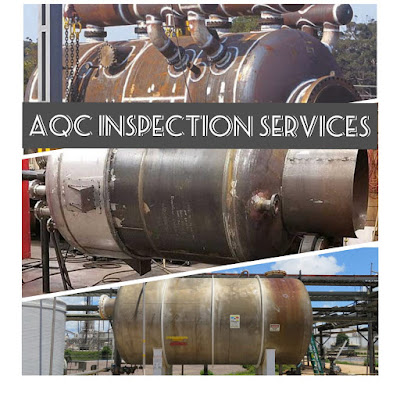
  What is pressure vessel? Pressure vessel is closed container which holds liquids or gasses at a pressure greater than the atmospheric pressure. Definition of Pressure vessel as per ASME BPVC section VIII , Div 1, U1, Pressure vessel are containers for containment of pressure, either external or internal. This pressure may be obtained from a external source or by application of heat. Heat can be applied either by a direct or indirect source, or any combination thereof . Types of pressure vessel based on their purpose : Storage vessel- used primarily for storage of liquids or gases in a pressurized state. Process vessel – vessels in which any of the below operations are performed. Seperation of products combining products breaking down and removing various elements as by products or impurities (Ex. Seperator, reactor, distillation tower, heat exchanger, drums, fractioning tower, etc.) Fired and Un fired pressure vessel Fired pressure vessel – ...