Posts

Showing posts with the label welding inspector course

Safety and Precautions during welding
Image
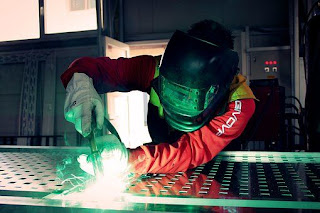
  As in any welding process,   safety precautions  are very important. All information relating to the safe operation of the welding equipment and process must be fully understood before beginning work. A careless welder who does not observe some simple rules can cause a dangerous situation for everyone. The process of  arc welding creates several hazards  which must be guarded against. If the welding machine has the characteristics of a transformer or a motor-generator design, electrical energy is required as primary power to operate it. Useful safety information can be found in the Owner’s Manual that comes with each item of welding equipment. 1.  Electrical Shock: Welders must be concerned about the possibility of electrical shock. It should be remembered that electricity will always take the path of least resistance. A welder should never weld while standing in water. If wet working conditions exist, certain measures should be taken. Such measures inclu...
Weld Crack

Image
  Weld crack   1.1. Cracking: If a weld crack is found, it must be removed and magnetic-particle inspection performed to ensure every point has been removed before re-welding. Weld Crack can occur on top of a weld bead, within the weld, or in the base metal. GMAW electrode wires are low hydrogen in content and have no flux coating to attract moisture, can help avoid cracking in the weld and heat-affected zones, if kept clean and dry. Spools or reels must be free of moisture both while being used and when being stored. A crack can easily occur on welding of aluminum, due to metal contraction as the weld pool cools, while the base metal remains hot. Cracks may be more numerous with aluminum, but they may also occur in stainless steel and galvanized materials. Cracks may occur if excess heat input is used for the particular thickness of material being welded, or steels with high carbon content, over 30 %, are likely to crack due to their hardness. Spatter: If there is a lot of sp...

https://aqcinspection.com/welding-inspector-certification/

Image
  Levels of Certification AWS 1:2003 There are three levels of qualifications for welding inspector personnel. These levels are: AWI  – Associate Welding Inspector; WI  – Welding Inspector; SWI  – Senior Welding Inspector. 1.1)      Associate Welding Inspector (AWI): Shall be a  high school graduate , or hold a state or military  approved high school equivalency  diploma. Shall have a  minimum of two years’ experience  in an occupational function with a direct relationship to weldments fabricated to national or international standards and directly involved in one or more of the areas. 1.2)      Welding Inspector (WI):   Shall be a  high school graduate , or hold a state or military  approved high school  equivalency diploma. Shall have a  minimum of 5 years’ experience  in an occupational function with a direct relationship to welded assemblies fabricated to natio...

Cast Iron and Its Types

Image
  What is a cast iron? Cast iron are ferrous alloys with greater than 2% carbon. They also contain small amounts of other materials such as silicon, sulphur, manganese, & phosphorous. In general it consists alloys of carbon & iron. They are the least expensive of all metals and is found plentiful resource than next to aluminium. What makes cast iron an important material? It is a cheap metallurgical substance. Good mechanical rigidity and good strength under compression. Easy castablility. Good machinability can be achieved when a suitable composition is selected. Composition : Carbon – 3.0 to 4.0% Silicon – 1.0 to 3.0% Manganese – 0.5 to 1.0% Sulphur – upto 0.1% Phosphorus – upto 1.0% Influence of cooling rate on the properties :   Types : Grey (General purpose) White (Hard & Wear resistant) Malleable (Heat treated for ductility) Spheroidal Graphite (Some ductility) Grey Cast Iron: It is the least expensive & the most common type of cast iron. It is an alloy o...