Posts

Showing posts with the label UT certification

Ultrasonic Testing for materials

Image
  What is Ultrasonic Testing? ULTRASONIC TESTING is a method for sending ultrasound into material and analyzing the returning sound waves for defect free components. It use scanning devices called probes. After application of Couplant over the material surface probe is place over the material. The sound travels to the end of the material and reflects back to the probe. There will be a change in acoustic property between the material and air. As a result the reflection sound is noted as back wall echo in the UT flaw detector machine screen. How to scan for defects in Ultrasonic Inspection? If the sound waves meet a defect in between the front walk and back wall, again there will be reflection due to acoustic property. Difference between the material and defect material, which appears between the initial sound echo and back wall echo. Thus any defect inside the material is detected by noticing the defect echos in between the initial echo and backwall ec...
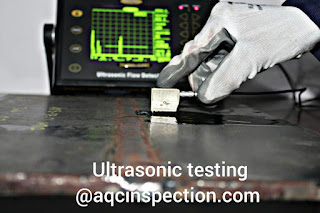
Procedure for Ultrasonic Testing

Image
What is Ultrasonic Testing ? Ultrasonic testing is the process of  detecting internal defects by use of high frequency sound waves which are non audible to human ears. The method can be used to detect flaws inside any solid material. Why is a procedure required for UT ? Any industrial operation requires a work instruction or working procedure. When it comes to special techniques like NDT – Non Destructive Testing, it is essential to have an approved procedure. They  have references from any of the international standards. Few of the global inspection standards for Ultrasonic Testing are given below: ASME Boiler & Pressure Vessel Code – Section V BS EN ISO 17640 (British & ISO Standard ) SAE AMS 2630, SAE AMS 2632 – (Aero Space Standards) How to make a Ultrasonic testing Procedure A Procedure should contain the below important contents Scope (What is range, material, type of material or weld joint the procedure covers, technique) References (the International or local S...

How is Ultrasonic testing used for finding defects?

Image
All you need to know about Ultrasonic Testing from AQC- Best Ndt Training Institute and Ultrasonic Testing Service provider in Coimbatore , TamilNadu, India Ultrasonic Sound is sound propagating in higher frequencies that are not audible to human ear. Generally sound with frequency (Frequency number of cycles per unit time) more than 20,000 Hertz is known as ultrasonic. For creation of sound we need to vibrate any matter, therefore in Ultrasonic testing we make a crystal to vibrate in higher frequency (generally  20,00,000 times) to produce Ultrasonic sound waves. These sound waves travels into material , and gets reflected back when it hits any different matter of different elastic property. For the purpose of creation of sound and receiving of sound we use Piezoelectric Crystal. What is Piezoelectric Crystal? The crystal grains which makes mechanical vibrations when electricity is applied and vice versa. The Crystal creates electric energy when mechanically vibr...

Ultrasonic Testing(UT) Inspection Services

Image
What is the defect size accepted in Ultrasonic Testing ? Indications which are identified using any NDT method is accepted or rejected in reference with the standards. The standards which client accepts or the standard which we follow for production  is called as acceptance criteria. Few of the important acceptance criteria are given in this blog.For more detailed understanding of NDT, Ultrasonic testing(UT) inspection services and defects visit us on https://aqcinspection.com/ Acceptance Criteria : ASME Section VIII Division 1 – Pressure Vessel Construction – Ultrasonic Testing (UT) Inspection Services   These Standards shall apply unless other standards are specified for specific applications within this Division. Imperfections which produce a response greater than 20% of the reference level shall be investigated to the extent that the operator can determine the shape, identity, and location of all such imperfections and evaluate them in...