Posts

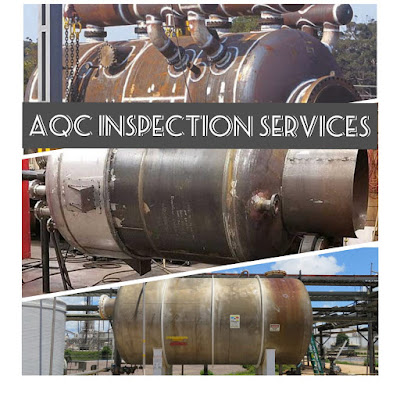
Pressure Vessel Inspection- Non Destructive Testing In Service

Image
  What is pressure vessel? Pressure vessel is closed container which holds liquids or gasses at a pressure greater than the atmospheric pressure. Definition of Pressure vessel as per ASME BPVC section VIII , Div 1, U1. Pressure vessel are containers for containment of pressure, either external or internal. This pressure may be obtained from a external source or by application of heat.Heat applied is either by a direct or indirect source, or any combination thereof. Types of pressure vessel based on their purpose : Storage vessel- used primarily for storage of liquids or gases in a pressurized state. Process vessel – vessels in which any of the below operations are performed, separation of products combining products breaking down and removing various elements as by products or impurities (Ex. Separator, reactor, distillation tower, heat exchanger, drums, fractioning tower, etc.) Fired and Unfired pressure vessel Fired pressure vessel – are pressure vessels where ...

How to get Welder Certificate?

Image
  What is welder qualification test? Welder Certificate is a document that shows ability of a welder to make a quality weld in a particular welding process. The Certificate also denotes on which type of welding material and which position the welder is able to perform. A full penetration weld can be performed by welder who is qualified for full penetration & fillet. A welder qualified by vertical position (3G) can perform Flat and vertical in production and so on. These qualification ranges are mentioned in the certificates after referring the applicable codes and standards. Welders are qualified for different process individually. Welding process: Shielded Metal Arc Welding (SMAW)- Arc Welding Tungsten Inert Gas Welding (TIG/GTAW)- Arc Welding Metal Inert Gas Welding (MIG)- Arc Metal Active Gas welding (MAG)- Arc Flux Cores Arc Welding (FCAW)- Arc Electric Resistance welding (ERW) and Lot more.. Welding Qualification standards : AWS D 1.1 ...

What is Acoustic emission testing?

Image
  ACOUSTIC EMISSION TESTING (AET) Acoustic Emission Test is a type of Non – Destructive Test method generally used for detecting and locating imperfections in mechanically loaded structures or components. Flaw origination and progression in a stressed component can be identified by acoustic emission test method.This can be done when the component is subjected to repetitive or continuous stress.   PRINCIPLE OF ACOUSTIC EMISSION TESTING AET: When a component with discontinuities is subjected to mechanical load or stress it releases energy. This energy travels in the form of high frequency stress waves. These waves or oscillations are received with the use of sensors which in turn converts the energy into voltage. This voltage is electronically amplified with the use of timing circuits and further processed as AE signal data. STAGES IN ACOUSTIC EMISSION TESTING (AET): External forces acting on a body; the resulting stress causes deformation wit...

Inspection of Pressure vessels

Image
  What is pressure vessel? Pressure vessel is closed container which holds liquids or gasses at a pressure greater than the atmospheric pressure. Definition of Pressure vessel as per ASME BPVC section VIII , Div 1, U1, Pressure vessel are containers for containment of pressure, either external or internal. This pressure may be obtained from a external source or by application of heat. Heat can be applied either by a direct or indirect source, or any combination thereof . Types of pressure vessel based on their purpose : Storage vessel- used primarily for storage of liquids or gases in a pressurized state. Process vessel – vessels in which any of the below operations are performed. Seperation of products combining products breaking down and removing various elements as by products or impurities (Ex. Seperator, reactor, distillation tower, heat exchanger, drums, fractioning tower, etc.) Fired and Un fired pressure vessel Fired pressure vessel – ...

Heat Treatment of Alloys

Image
  What is an Alloy? Since metals are insoluble in water, alcohol; they are mixed with other metals in molten state which upon cooling solidifies to a solid mixture called an Alloy. This solid state mixture is also referred as a homogeneous liquid mixture. Alloys are formed by mixing a metal with metal or a metal with a non metal. From the above explanation it is clear that an alloy contains atleast one metal. What are the properties of an alloy? Alloys are harder, less malleable. They possess low melting points, low electrical conductivity. They resist corrosion and actions of acids. What is the purpose of alloying metals? To increase the hardness of the metal To lower the melting points of metals. To resist the corrosion of the metal. To modify the chemical activity of the metal. To modify the colour of the metal. To get good casting of metal. Effects or Functions of Alloying Elements: Addition of small amount of certain metals imparts some special properties like hardness, tensil...

Ultrasonic testing Couplants

Image
 A study on the couplant effects in contact ultrasonic testing. The primary purpose of a couplant is to provide a suitable sound path between the transducer and the test surface.Ultrasonic Testing couplants usage can be seen here A couplant must effectively wet or totally contact both surfaces of the transducer and the test part. The couplant must exclude all air from between the surfaces as air is a very poor conductor of sound. The couplant fills in and smoots out irregularities on the surface of the part. The couplant aids in the movement of the transducer over the surface in contact testing. The practical couplant must be easy to apply and easy to remove. It must also be harmless to the part surfaces. How to Pick the Right Ultrasonic Couplant for Your Application? Oil or water mixed with Glycerin (2 parts water and 1 Part glycerin) are commonly used couplants. Even wallpaper paste has advantages as couplant. Heavier couplants, such as Grease or heavy Oil can be ...

Rebound Hammer Test-Non Destructive testing on Concrete

Image
  Non destructive testing for concrete Non Destructive Testing is the process of detecting the quality without destructing the material or without changing its actual properties. Rebound Hammer is also called as Schmidt hammer or Swiss Hammer or Concrete hammer test. This NDT method is used to detect the strength of Concrete Slab or rock, by identifying the hardness or elastic property. Principle of Rebound Hammer Test. Schmidt’s hammer test is based on the principle of “rebound of a spring loaded mass depends on the hardness of the concrete mass on which the mass strikes”. This rebound distance of the rebounded Plunger mass is noted down in the graduated scale as Rebound number / rebound  index. The graph in the body of hammer is used to found out the respective compressive strength. The concrete with low energy and low stiffness absorbs more energy from plunger and produces a low rebound value on the scale. Objective of Hammer rebound test...